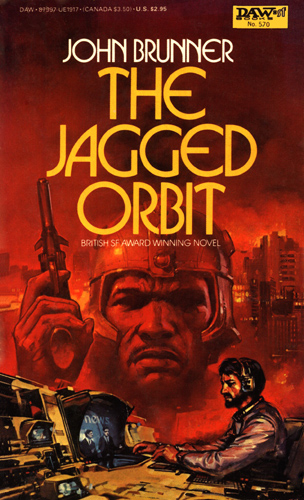
|
This novel, which followed on the heels of Brunner's masterpiece Stand on Zanzibar, is one of his most trenchant dystopias, yet it is as irresistible as it is biting. A richly deserving winner of the British SF Award, it may be one of the best and most entertaining and accessible examples of socially conscious (for lack of a better term) SF ever written, demanding repeated readings before you have peeled away all of its layers. And it's remarkable how timely the story remains today, despite its being very much a product of its turbulent era. Brunner was always a canny observer of human nature, and, as he does in so many of his best books, he reminds us how, where humanity's deepest failings are concerned, the more things change the more they stay the same.
We're in New York, 2014, and the world at large has been overcome by paranoia and social unrest, which has found its most extreme expression in racial division. Blacks are called "knees" and whites "blanks," and segregated knee enclaves exist throughout the US as self-governing entities. Moreover, this state of affairs is perpetuated by the powers that be, who find it more profitable to pander to humanity's fears and collective insanity than to help us rise above them. If a riot has to be quelled by taking out whole city blocks with missiles, so be it. Everyday citizens are exploited by arms dealers like the Gottschalks, who promote the idea of security through greater firepower. As one character puts it, "they live off the carrion of our mutual distrust and bribe us with symbols that equate hatred with manhood." This is frighteningly prescient storytelling. In 2008, when America elected its first African-American president, gun stores around the country saw a huge spike in business, exploiting not only their customers' irrational fears that gun ownership would soon be outlawed, but, in a coldly cynical way none of them would ever admit to, their racism as well.
Brunner's elaborate canvas displays many memorable character portraits. Matthew Flamen is a "spoolpigeon," a sort of tabloid-TV journalist or radio shock jock who chases after rumors and specializes in uncovering the dirty laundry of prominent public figures and corporations for the public's entertainment. Flamen's wife has for some time been institutionalized under the care of one Elias Mogshack, a psychologist who believes that institutionalization in a culture of such extreme social unrest is perfectly normal and desirable, and preaches a philosophy of "individualism" so dogmatic that his most "successful" patients have become withdrawn into themselves past the point of no return. One of the institution's doctors arranges a performance by a "pythoness," a young woman named Lyla Clay who, mainly through the assistance of psychoactive drugs, possesses the mental ability to empathize with the insane and hopefully draw them out of their malaise. The performance fails spectacularly, though not through any fault of Lyla's, giving Flamen and Dr. Jim Redeeth all the proof they need that Mogshack and his whole hospital are a farce and setting them on a course designed to bring down this man whose influence in society as a whole is getting too strong for comfort.
Mixed in with all of this are enough subplots to make entire novels unto themselves, played out by brilliantly realized and witty characters and masterfully woven together. Brunner also shows a mastery of dialogue that you won't find too often in SF of the period, including many of Brunner's other novels. Even chapters which involve little more than philosophical debate aren't the least bit preachy or dull. It's like attending a party full of close friends who enjoy nothing more than talking about these things well into the wee hours. If you've never thought that an SF novel rooted mainly in ideas could be as lightning-paced and exciting as the best space opera, prepare to have your horizons expanded. Brunner can keep you rooted to your chair and rooting for the book even while his future and all of its dysfuntional players seem determined to race towards their own destruction.
While Stand on Zanzibar is one of the very few Brunner novels still in print today, and deservedly so (you have to hit the used bookstores to get most anything by Brunner nowadays), The Jagged Orbit desperately needs to be back in print and on the shelves right next to it. I honestly think that in post-LA riots America, in a country where racial divisions and bigotry are still deeply entrenched despite the enthusiasm with which we're trying to embrace hope and change, this undidactic, witty, and electrifying novel is as relevant as ever and should find a whole new generation of fans.
|



 THE JAGGED ORBIT