| | |

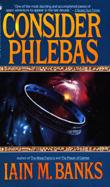
CONSIDER PHLEBAS
1987

Review © 2001 T. M. Wagner.
Book cover art by Paul Youll.

AUTHOR'S SITE

IAIN M. BANKS


Iain M. Banks is not a writer who is terribly well-known in the U.S., and that fact points to a truly sad state of affairs in American SF publishing. What a shame it is that fanboys line up around the block to buy the latest assembly-line Star Wars Product™, while the work of this extraordinary writer goes unnoticed by anyone save the most dedicated and adventurous readers. Consider Phlebas is so many things: breathlessly exciting space opera, yet starring a morally ambiguous antihero; a story which both embraces and rejects the romanticism of space adventure; a story which unsettles as often as it thrills. Banks demands a lot from his readers and challenges them, while managing to keep his story accessible and absorbing. He's quite unlike anyone writing in the field today.

The novel is set in Banks' Culture milieu. The Culture is a starfaring society run by benevolent machines; its enemies, the Idirans, are a more traditional, religious race. And the two are at war, with the Idirans winning, because, after all, they fight the encroachment of the Culture with a passionate fervor while the humans living within the Culture are generally soft and satisfied, and have had to learn to harden themselves for the realities of warfare. Banks refuses to draw good guy/bad guy conclusions about either side, depicting instead a conflict between ideologies, each convinced it is operating in the best interests of living beings in general.

Horza Gobuchul belongs to the race of the Changers, humans with the ability to alter their bodies (though it's a trying task; they cannot simply "morph" themselves Terminator 2 fashion). Though Changers are officially neutral in the war, Horza has thrown his lot in with the Idirans, whose passion and lust for life he admires compared to the perceived sterility of the Culture, and for whom he now works as a spy. When a unmanned Culture craft is pursued to Schar's World — a forbidden "planet of the dead," inaccessible to either side — Horza is charged by the Idirans to travel there and somehow recover the craft's Mind, a super-sentient AI of the sort that runs all of the Culture's dazzlingly advanced machinery. However, Horza finds himself stranded in space, only to be recovered by the crew of the Clear Air Turbulence, a gang of mercenaries and pirates who are on their way to the Vavatch Orbital, a Ringworld-like artificial habitat due to be destroyed imminently by the Culture to prevent its falling into the Idirans' hands. The Turbulence and its somewhat incompetent captain Kraiklyn hope to do a bit of last-minute looting.

All of this goes awry, naturally, propelling Horza on a series of incredible adventures (and misadventures) in his attempts to get, somehow, to Schar's World, where not only his mission, but a former lover, a Changer woman he spurned years ago, awaits.

The resulting novel is something like a Star Wars entry directed by David Fincher. The reader is treated to one jaw-dropping setpiece after another, including an "I can't believe this is happening" encounter with a deranged cannibal (more than a bit grisly, I fear), and an explosive chase-and-escape sequence out of Vavatch that may be one of the most exciting scenes of its type in recent SF. Banks' imagination seems boundless; and when he borrows (or swipes), he does so unabashedly. Yes, the Orbitals and their vast city-sized Megaships are right out of Niven, but Banks simply lays claim to the ringworld concept and incorporates it into his story as if Niven's invention were just as deserving of being a universal SF trope as robots, hyperspace, and laser guns. (And honestly, it is.)

Banks' prose is lush and quite dense at times, and yet always extremely readable and evocative. In addition, the characters grow on you and elicit sympathy because they act believably towards one another and their situations, never falling into stereotypical roles that call for contrived heroism or villiany. You'll find yourself eagerly flying through this novel simply to see what astounding thing could possibly happen in the next chapter. It may be all a bit much for some readers, but you can't deny there is some formidable creative energy at work here.

Banks has written several Culture novels, each of which can be read as a self-contained story; Consider Phlebas is commonly considered one of the best, as well as a good one for new readers to start the series with. I second that emotion. As I mentioned, Iain Banks doesn't enjoy nearly the recognition in this country as he does in England and his native Scotland. I hope I can help a few of you turn that situation around. You would do well to consider Consider Phlebas.